

The term "agentic marketing" is suddenly everywhere. Every B2B marketing vendor is rushing to declare the dawn of a new era powered by autonomous AI agents. It's a compelling vision.
It's also, for the most part, a marketing veneer painted over a decade-old chassis.
Most platforms claiming to be "agentic" are still fundamentally rule-based chatbots. They've swapped out a few decision trees for a large language model, but the core architecture hasn't changed. As I wrote when Salesforce acquired Qualified last December, any platform built before 2023 has to undergo a complete rebuild to become truly agentic. You can bolt on AI features. You can't bolt on an AI-native foundation. That's a rebuild.
This isn't a semantic argument. It's the difference between a platform that automates and one that actually understands.
But before we get into who's faking it and why, let's be precise about what Agentic Marketing actually means. Because the category is real. The operating model it describes is real. And the gap between it and what most vendors are shipping is large enough to drive a sales cycle through.
Three Eras. One Shift That Actually Matters.
Marketing has moved through three distinct operating models. Most companies are still stuck in the second one.
Human-Led Marketing was the past. Humans did the work. Systems stored data and automated simple rules, but every meaningful decision — a follow-up, a qualification call, a campaign change — required a human to initiate it.
Assisted Marketing is the present. AI helps people move faster. It drafts emails, scores leads, summarizes calls, suggests segments. The workflow is still human-led. The AI is a very smart intern.
Agentic Marketing is the next operating model. Autonomous agents execute meaningful marketing tasks — qualification, discovery, routing, follow-up, conversion — under human direction and governance. The human sets objectives, guardrails, and oversight. The agent handles execution. The human is no longer the bottleneck for every action.
That last sentence is the whole point. Marketing teams today can't scale if humans remain the execution layer for everything. As volume rises, channels multiply, and personalization demands grow, the human bottleneck becomes the limiting factor. Agentic Marketing is the answer to that constraint. Not a chatbot with a better LLM bolted on.
The Broken Promise of the Chatbot
For years, B2B marketing ran on a flawed operating system. We invented the MQL as a proxy for intent, incentivizing a flood of low-quality leads that burned out SDRs. Legacy chatbots were the next patch — promising to automate engagement and keep the lead machine humming.
They quickly showed their limits.
They're rigid. Built on branching decision trees, they force buyers down a predefined path. Any deviation and you hit the dead end: "I can't answer that. Would you like to speak to a human?"
They offer a poor experience. Buyers today expect the instant, accurate answers they get from ChatGPT. They have zero patience for clunky, form-like conversations that feel more like an interrogation than a conversation.
And they fail at the moment of truth. When a high-intent buyer asks a specific technical question about your product, the chatbot deflects. It can't answer, so it routes. That introduces friction and delay at the most critical point in the buyer's journey.
The result? A leaky funnel and a frustrated buyer. The very tool meant to improve conversion became a barrier to it.
These are not edge cases. This is the structural ceiling of Assisted Marketing: the human or the human-built script remains in the way of every real answer.
The "Agentic" Veneer: A One-Question Test
Now, these same legacy platforms are rebranding as "agentic." They claim their new AI capabilities have solved these problems. I'd propose a simple, one-question test to find out.
Ask it a complex, multi-part technical question about your own product that isn't explicitly stated on your pricing page. Something like: "How does your Salesforce integration handle custom objects, and does it sync activity history in real-time or on a delay?"
A legacy chatbot with an AI layer will parse the keywords and respond with a generic link to a help article or, inevitably, "A sales rep can help with that."
A true AI marketing agent will answer the question — accurately, conversationally, and in seconds. The difference isn't the AI model. It's what the AI has access to.
When I was at ZoomInfo building their chat solution, this was the ceiling we kept hitting. No matter how sophisticated the routing or how clever the conversational design, the system couldn't access and synthesize deep, unstructured product knowledge. That was the fundamental roadblock. It's why we built Docket on a completely different premise.
What Makes an AI Agent Actually Agentic?
A true AI marketing agent is defined by one thing: it can understand, reason, and act on a deep and dynamic body of knowledge. The revolution isn't automating SDR tasks. It's having an AI that actually knows your product as well as your best sales engineer.
But knowledge is only part of the answer. The other part is the operating model change.
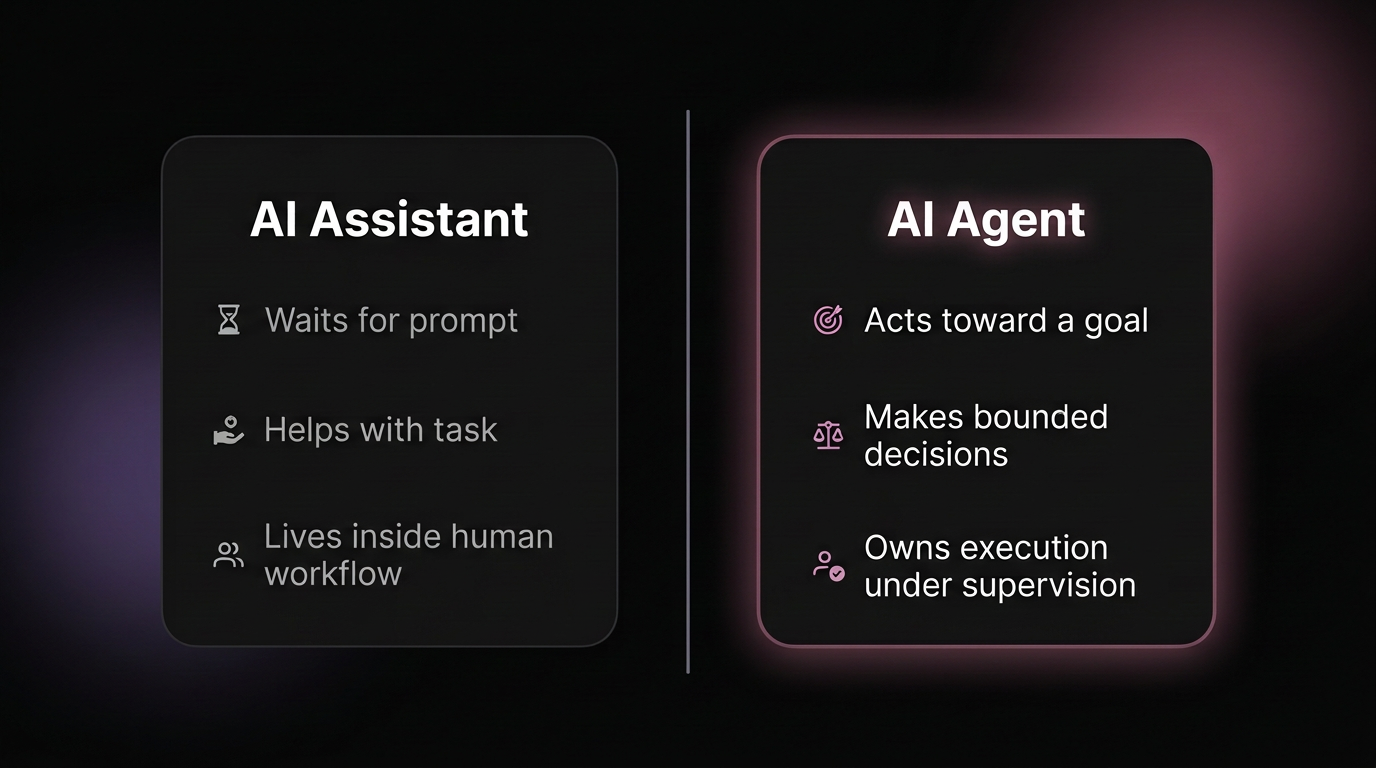
An assistant waits for a user, helps with a task, and lives inside a human workflow. An agent acts toward a goal, makes bounded decisions, triggers workflows, and owns part of execution under supervision. That distinction sounds philosophical. It isn't. It's the difference between a tool that makes a marketer 20% faster and a platform that lets your marketing org handle 10x the volume without 10x the headcount.
At Docket, we built the Sales Knowledge LakeTM to make this possible. It unifies all of a company's structured and unstructured data — website content, marketing docs, the messy but invaluable knowledge locked in Slack threads, Gong calls, and Notion pages. It resolves conflicts, learns continuously, and recrawls your website nightly. That's what allows our AI Marketing Agent to answer that complex technical question with confidence, not a redirect.
And here's the part nobody else is talking about: when you give buyers an AI that can actually answer their questions, they don't want to type. They want to talk.
Across our first 50 customers, 70% of conversations happen via voice. Not text. Voice.
That number surprised even us at first. But it makes complete sense. When you remove the friction of typing and the awkwardness of talking to a human sales rep you've never met, the most natural thing in the world is to just speak. Buyers tell the AI exactly what they need — use case, pain points, timeline — in a two-minute voice conversation that would have taken fifteen minutes of form-fills and email ping-pong.
That's not an incremental improvement. That's a fundamentally different buying experience.
Autonomy Without Control Is Just Risk
There's a fair objection at this point: if AI is executing autonomously, who's in charge?
It's the right question. And it's exactly where a lot of the "agentic" vendor landscape gets hand-wavy.
Real agentic execution doesn't mean unconstrained AI doing whatever it wants on your website. It means autonomous execution inside trusted guardrails. Humans define objectives, escalation rules, topic constraints, and approval thresholds. The agent operates within those boundaries. When something falls outside them, it escalates.
This is what enterprise-grade agentic marketing actually looks like: the agent handles the 90% of interactions that are repeatable, signal-driven, and bounded. The human handles judgment, edge cases, and governance. Nobody is handing over the keys. They're just stopping humans from manually driving every single car.
If a vendor can't explain their governance model in concrete terms, they're not agentic. They're just autonomous in a way that should concern your legal team.
What This Looks Like in Practice
This shift from rule-based interaction to knowledge-based conversation reshapes the entire marketing funnel.
These aren't projections. They're what we're seeing across our customer base since launching our AI Seller agent in May 2025.
The impact goes beyond marketing. Jack Torlucci, Senior Director of Solutions Consulting at Demandbase, told us that before Docket, the number one complaint from his sales reps was that their Solutions Consultants were too slow to respond. That's a bottleneck story. Humans were the execution layer — every answer required a human to find it, synthesize it, and deliver it. Three quarters after deploying Docket, that complaint has disappeared entirely:
"We don't have situations now where sales reps are going to a leader and saying, 'This person is not responsive enough.' Because now, the SCs are not spending all that time digging for the answer. They're just giving the answer." — Jack Torlucci, Sr. Director of Solutions Consulting, Demandbase
When asked how likely he is to recommend Docket on a scale of 1 to 10, Jack's answer was simple: " Most of my team probably can't imagine working without it at this point."
The $150,000 Question
IIf you're a VP of Demand Gen paying $150,000 a year for a platform like Qualified and you believe you already have "agentic marketing," ask yourself one question: Can your agent answer a nuanced question about data compliance or a competitive differentiator without defaulting to "Contact Sales"?
The reason it can't is architectural. Qualified was built in 2018 as the best chatbot integration with Salesforce — and that was a smart positioning at the time. But their AI SDR, Piper, was OEM'd technology from another vendor, not built in-house. When they needed to go agentic, they couldn't rebuild from the ground up. They sold to Salesforce instead. Drift, which hit $150M in ARR at its peak, followed a similar arc — acquired by Vista, then Salesloft, and effectively sunset.
These aren't failures of ambition. They're failures of architecture. Platforms built in the Assisted era cannot become agentic through an upgrade cycle. The operating model is different. The data layer is different. The trust architecture is different.
The real question isn't whether AI agents are better than chatbots. That answer is settled.
The real question is whether you're going to wait for your legacy vendor to finish a rebuild they may never complete — or whether you're going to give your buyers the experience they're already asking for, out loud, right now.