3–6%
Conversation start rate vs 1–3% on legacy flows
3 days
Typical go-live. Faster than any competitor.
15%
Lift in qualified pipeline for Docket customers

What you get with Docket that 1mind doesn't offer

A knowledge graph, not a trained model

1mind trains a model on your documents. Docket builds a structured graph: product, competition, objections, case studies, and ROI, all interconnected. When a buyer asks a hard multi-part question, Docket reasons across topics. 1mind pattern-matches.
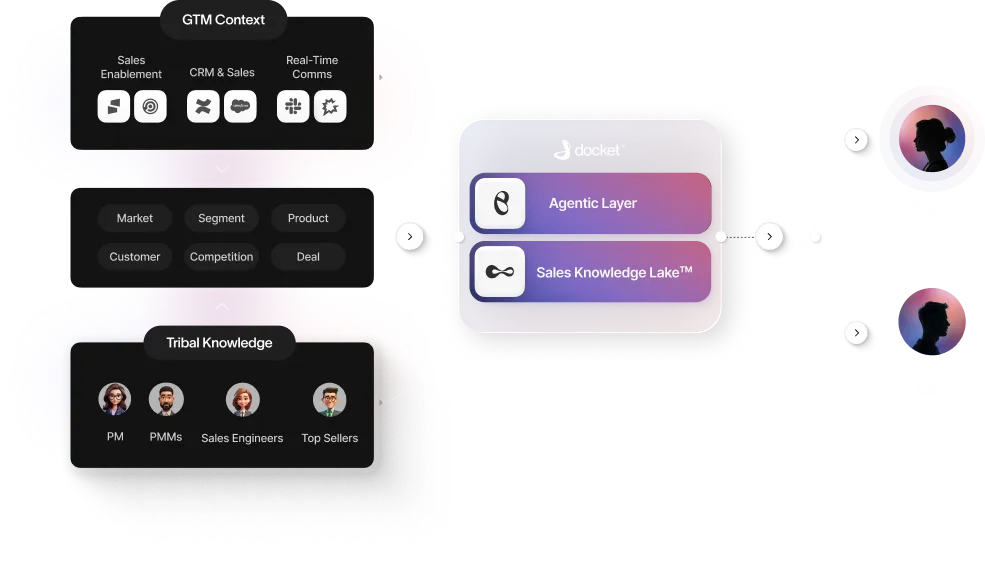
Sales Knowledge Graph

Per-agent knowledge scoping and routing rules

Docket lets you deploy separate agents per product, segment, or campaign, each with distinct knowledge scope and routing rules. You can A/B test them. 1mind supports multiple agents, but per-agent scoping and routing rules are not published.

Per-agent knowledge scoping

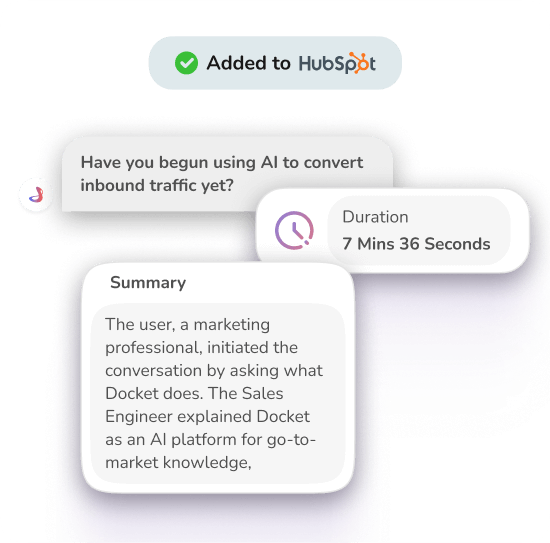
Live on your website in 4 days

Your team commits 4 to 6 hours. Docket's CS team handles knowledge ingestion, CRM setup, and agent configuration. 1mind requires avatar production, persona workshops, and multiple testing rounds before launch.
Live on your website in 4 days

1mind's Mindy is genuinely impressive. The question isn't the face — it's the knowledge behind it, the time to deploy, and what keeps it current. If photorealistic avatar aesthetics are your top requirement, 1mind is worth evaluating. If deployment speed, knowledge accuracy, and integration depth matter more, read on.

The demo is not the deployment.

Docket vs 1mind AI

1mind's avatar technology is real. So is the implementation cost, the absence of per-agent knowledge scoping, and the manual knowledge management.

Docket
1mind AI
Knowledge architecture
Structured Sales Knowledge Lake: an interconnected graph across objections, competitors, case studies, discovery questions, and ROI. Enables relational reasoning across topics.
Content-trained model. No published knowledge graph. Knowledge depends on content fed during onboarding workshops.
Multi-agent deployment
Deploy multiple agents across chat, voice, and email. Each gets its own behavior, knowledge scope, starting rules, and directives. A/B test agents.
Multiple agents supported. Per-agent knowledge scoping, routing rules, and A/B testing not published.
Integration breadth
100+ native integrations: Slack, Gong, SharePoint, Drive, Salesforce, HubSpot, Intercom, and more. Ingested automatically via Dynamic Context Ingestion.
Salesforce, HubSpot, Zoom, Teams, and Slack confirmed. No Gong or SharePoint ingestion confirmed. No published integration count.
Knowledge sync
Nightly automatic refresh. Product and pricing changes are live the next morning without any action from your team.
No nightly sync published. Content is updated manually during workshops. Changes require re-engaging the 1mind team.
Go-live timeline
4 to 5 days typical. White-glove onboarding handles the heavy lifting. Around 4 to 6 hours of your team's time required.
Avatar production, persona workshops, content ingestion, and multiple testing and iteration rounds required before launch.
Multilingual support
40+ languages with on-the-fly switching within the same conversation. No setup required per language.
Language support beyond English not independently confirmed.
Pricing
Transparent, published pricing. Starts at $36,000/year. Predictable.
Custom enterprise pricing. No published tiers. Usage-based. Subject to required needs and external integrations.
Docket
1mind AI
Knowledge architecture
Structured Sales Knowledge Lake: an interconnected graph across objections, competitors, case studies, discovery questions, and ROI. Enables relational reasoning across topics.
Content-trained model. No published knowledge graph. Knowledge depends on content fed during onboarding workshops.
Multi-agent deployment
Deploy multiple agents across chat, voice, and email. Each gets its own behavior, knowledge scope, starting rules, and directives. A/B test agents.
Multiple agents supported. Per-agent knowledge scoping, routing rules, and A/B testing not published.
Integration breadth
100+ native integrations: Slack, Gong, SharePoint, Drive, Salesforce, HubSpot, Intercom, and more. Ingested automatically via Dynamic Context Ingestion.
Salesforce, HubSpot, Zoom, Teams, and Slack confirmed. No Gong or SharePoint ingestion confirmed. No published integration count.
Knowledge sync
Nightly automatic refresh. Product and pricing changes are live the next morning without any action from your team.
No nightly sync published. Content is updated manually during workshops. Changes require re-engaging the 1mind team.
Go-live timeline
4 to 5 days typical. White-glove onboarding handles the heavy lifting. Around 4 to 6 hours of your team's time required.
Avatar production, persona workshops, content ingestion, and multiple testing and iteration rounds required before launch.
Multilingual support
40+ languages with on-the-fly switching within the same conversation. No setup required per language.
Language support beyond English not independently confirmed.
Pricing
Transparent, published pricing. Starts at $36,000/year. Predictable.
Custom enterprise pricing. No published tiers. Usage-based. Subject to required needs and external integrations.
Based on publicly reported pricing
$100,000+

reported starting price for 1mind

That's before avatar production, persona workshops, and iterative testing rounds — all of which require significant time from your team before you see a single qualified lead. Custom enterprise pricing means you won't know the real number until you're deep in a sales process.

Docket starts at $36,000/year. Published. Predictable. Includes white-glove onboarding and goes live in 4 days.

Pricing based on publicly available information and market reports. Individual contract terms may vary.

See Your Agent In Action

Why teams are replacing 1mind with Docket

Your Agent Learns From Your Best Reps, Not Random Docs

Most AI tools learn from whatever you upload: old decks, outdated pricing, conflicting docs from three different people.

Docket's preprocessing filters the noise before it reaches your agent. It removes call chit-chat, deduplicates drafts, and prioritizes current documentation. Your agent answers from verified, governance-controlled content. 90% fewer AI mistakes.

Proprietary Knowledge Preprocessing

Every Answer Is Verified Before the Buyer Sees It

Docket runs four checks before responding: Retrieve, Reason, Critique, Verify. Every answer is source-cited and fact-checked against your approved content.

When Docket cannot find a verified answer, it flags for human handoff. It never guesses. 1mind's primary fallback for hard queries is routing to a human. There is no published deep-answer mode for complex technical questions.

Triple-Verification System

Your Reps Get Coached in Real Time. Buyers Never Know.

Docket's LiveAssist runs silently on your rep's desktop. It listens to live calls and surfaces the right answer at the right moment: discovery questions, technical details, and competitive positioning. The rep gets the answer. The buyer gets a confident response.

1mind's Superhumans join calls as a buyer-facing participant. That is a different product. Docket coaches the rep. 1mind replaces the rep.

LiveAssist Rep Coaching

Ready for a 1mind alternative? Docket provides…

  • Structured Sales Knowledge Lake, not a content-trained model
  • 100+ integrations including Slack, Gong, SharePoint, Drive, Salesforce, and HubSpot
  • Nightly automatic sync. No manual re-engagement with a vendor team.
  • Per-agent knowledge scoping, routing rules, and A/B testing
  • Live in 4 days with around 4 to 6 hours of your team's time
Salesforce HubSpot Gong Slack Notion Google Drive SharePoint +93 more
Docket Integrations

Frequently Asked Questions

Does 1mind have a knowledge graph?
No. 1mind trains a model on your content during onboarding workshops. Docket's Sales Knowledge Lake is a structured, interconnected graph across product, competition, objections, case studies, and ROI. That enables relational reasoning across topics, not just pattern-matching against training data.
How does Docket's multi-agent setup differ from 1mind's?
1mind supports multiple agents. What is not published is whether each agent gets its own knowledge scope, routing rules, and directives. Docket lets you deploy separate agents per product line, segment, or campaign, each with distinct knowledge scope, starting rules, and directives. You can A/B test agents and control exactly what each one knows and how it behaves.
How long does 1mind take to go live?
1mind requires avatar production, persona workshops, and multiple testing rounds. One G2 reviewer noted: 'We did need to invest time in testing and iterating multiple times before launch.' Docket deploys in 4 to 5 days, requiring around 4 to 6 hours of your team's time.
Does 1mind integrate with Slack and Gong?
Confirmed integrations for 1mind include Salesforce, HubSpot, Zoom, Teams, and Slack (one-way push notifications; two-way Slack is on roadmap). Gong and SharePoint ingestion are not confirmed. Docket ingests from 100+ sources including Slack, Gong, SharePoint, Drive, CRM, and sales enablement platforms, automatically via Dynamic Context Ingestion, with nightly syncs to keep knowledge current.
How accurate is Docket compared to 1mind?
Docket uses a four-step verification process: Retrieve, Reason, Critique, Verify. It targets 95%+ accuracy with source citations on every response. When it cannot find a verified answer, it flags to a human rather than guessing. 1mind uses a deterministic AI layer for on-brand guardrails but does not publish an explicit verification methodology or accuracy target.
What happens when knowledge changes in Docket?
Docket runs a nightly automatic sync across all connected sources. Pricing updates, new product features, and competitive changes are reflected the next morning. No action required. 1mind content is updated manually during workshops and changes require re-engaging their team.

Ready to go live without the workshops? Try a faster, more connected 1mind alternative.

See Your Agent In Action