Cognism Review · Updated May 2026

Cognism Review 2026: the honest take on EMEA B2B data's category leader

Cognism is the strongest B2B sales intelligence platform for EMEA-focused teams, the only major provider with GDPR compliance treated as a first-class engineering concern, and the platform most reshaped by leadership change in the last 12 months. After parsing 700+ G2 reviews, two CEO transitions, the 2024 revenue jump to $83M, and 2026 procurement data, here's our honest read for buyers evaluating it.

Verdict

4.1 /5
★★★★☆

Best for

EMEA-focused teams with 30-500 reps on phone-heavy outbound

Skip if

You're US-majority pipeline or need data plus engagement in one product

Starting price

~$22,500/year for 5 users

The verdict

What you actually need to know about Cognism in 2026

Cognism is the strongest B2B sales intelligence platform for EMEA-focused teams. The database covers 440M+ contacts across 100M+ companies, with the deepest mobile coverage in UK, DACH, Nordics, Benelux, France, and Spain. Diamond Data (10M+ phone-verified records) claims 98% accuracy on the verified subset. GDPR compliance is built into the data layer, with Article 14 notifications baked into reveal flows and DNC screening across 15 countries (more than any major competitor). If you're a 30-500 rep B2B team selling into Europe, Cognism is the category-default pick. That part of the story is real.

But Cognism in 2026 is a different company than the one that raised $87.5M at unicorn framing in October 2022. Founder James Isilay stepped aside as CEO in February 2025 with Pete Daffern (Chair) named interim. On September 9, 2025, Dominic Allon (former Pipedrive CEO, ex-Google, ex-Intuit) became permanent CEO with Chris Evans appointed CRO. Tracxn pegs the 2024 valuation at $436M, suggesting either a down round or earlier valuation framing overstated. Revenue hit $83M in FY2024, up 30% from $64M in 2023, with roughly 467-481 employees. We map the full pricing impact in our Cognism pricing analysis.

The most telling data point in the platform: Diamond Data's 98% accuracy claim applies only to the phone-verified subset (roughly 10M records, or 2.3% of the full 440M database). Independent testing reportedly found 62.5% of mobile numbers, direct dials, and landlines incomplete across the full database. The Diamond on Demand verification service caps at roughly 50 contacts per month with a 48-hour turnaround. The UK ICO is also reportedly investigating seven complaints about data privacy practices, with Kaspr (the Cognism-owned LinkedIn extension) already fined by France's CNIL. If that math gives you pause, take a look at our shortlist of best Cognism alternatives.

Our verdict: 4.1 out of 5. Best-in-class EMEA data with a real GDPR moat. A documented gap for US-majority pipelines. Worth it for the right EMEA buyer who can negotiate the renewal escalators. Overpriced for the buyer who fits Apollo or Lusha better.
$83M
FY2024 revenue (+30% YoY)
440M+
Contacts across 100M+ companies
10M+
Diamond Data phone-verified records
3
CEO changes since February 2025

Skip the sales call

Ask anything about Cognism without getting on a sales call

This AI agent is trained on Cognism's entire public content library, integrations docs, and product pages. Ask pricing logic, feature trade-offs, security posture, integrations, what happens at renewal — get answers in real time. No form, no waiting list.

cognism.com · ai assistant Live
What it does

What Cognism actually is in 2026

Cognism calls itself a B2B sales intelligence platform. The plain-English version: it gives you verified business emails, mobile numbers, company firmographics, intent signals, and technographic data for B2B prospecting, with the strongest EMEA coverage in the category and GDPR compliance built into how the data layer works. It sits between your CRM and your sales engagement tool (Outreach, Salesloft, Apollo), feeding verified contact records into your sequences. Most enterprise EMEA-focused teams treat Cognism as the source of truth for European phone data.

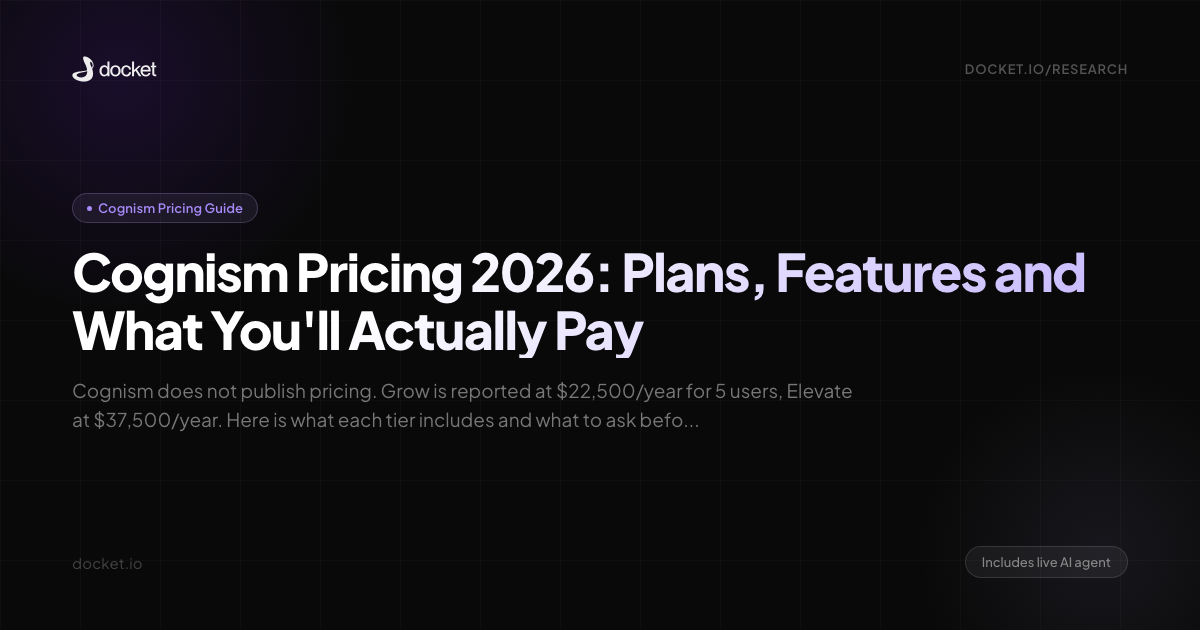
The two tiers matter more than the marketing for most buyers. Grow (also referred to as Platinum, reported at roughly $22,500 per year for 5 users) includes business emails and mobile numbers (not Diamond-verified), company intelligence (revenue, headcount, industry, location), CRM and sales tool integrations, target market analysis, and basic list exports (3 contacts per list). Elevate (also referred to as Diamond, reported at roughly $37,500 per year for 5 users, a 67% premium over Grow) adds Diamond Data phone-verified mobile numbers, intent data covering 12 topics (powered by Bombora), buying signals (job changes, funding, hiring, M&A), technographic data for 12 technologies, larger list exports (10 contacts per list), and access to the Diamond on Demand verification add-on.

Diamond Data verification methodology is the differentiator. Cognism employs a team of researchers who manually call mobile numbers to verify they reach the right person. When confirmed, the record receives a Diamond badge. The 98% accuracy claim applies only to this verified subset, not the full database. Diamond on Demand lets customers flag high-priority prospects for manual verification, with three outcomes: Diamond Verified, Improved (new data, not Diamond-grade), or No Improvement. The cap of roughly 50 contacts per month with a 48-hour turnaround is widely reported by customers but not explicitly published in Cognism's help docs.

What ships well versus what gets marketed: EMEA contact data, GDPR compliance, Diamond Data on the verified subset, the Bombora intent integration, and CRM and sales tool connectors are all mature and best-in-class for the European use case. Sales Companion (launched March 2025) is the AI-powered prospecting assistant. Cortex AI powers Smart Personas, AI Search, and Research by Cortex. Cognism Engage (new in 2025) is the native sequence builder, the first step toward closing the engagement-layer gap versus Apollo. Most customers still pair Cognism with Outreach, Salesloft, or Apollo for execution rather than relying on Engage. The Kaspr LinkedIn extension (acquired April 2022) operates as a distinct freemium product.

Ideal customer

Who Cognism is actually built for

Cognism is built for B2B sales organizations with 30-500 reps selling primarily into EMEA markets (UK, DACH, Nordics, Benelux, France, Spain), running phone-heavy outbound motions where mobile connect rates drive economics, and where GDPR or DNC compliance is a procurement requirement. Financial services, healthcare, regulated SaaS, and public sector buyers consistently pick Cognism for the compliance posture alone. The 6,400+ customer count and $83M FY2024 revenue validate this product-market fit at scale.

It assumes you already have an engagement layer. Cognism is a data and intelligence platform, not a sales engagement tool. Cognism Engage launched in 2025 but most customers still pair Cognism with Outreach, Salesloft, or Apollo for sequencing, dialing, and conversation intelligence. The honest stack is Cognism for European phone data plus your engagement tool of choice. For organizations comparing total cost of ownership, factor in the engagement-layer license alongside the Cognism contract.

The ideal buyer is an EMEA-first B2B organization at $20-$100 million ARR running structured outbound into European markets, with a procurement function that values GDPR compliance, and willing to commit to an annual contract at $15,000-$150,000+ per year depending on team size. For regulated industries where contact data sourcing has to defend itself in a privacy audit, Cognism's Article 14 notifications and 15-country DNC screening are genuinely defensible.

Conversely, if you have majority US pipeline, you should evaluate ZoomInfo for the deeper US database, Apollo for the all-in-one data plus engagement product at a fraction of the cost, or Lusha for SMB-friendly published pricing. Cognism's US, Canada, and APAC data coverage lags significantly behind EMEA, with reviewers consistently reporting weaker match rates, more outdated records, and higher bounce rates on US contacts. If you're under 30 reps, Lusha at $49-$149 per user per month with published pricing and a free plan delivers most of the entry-level value at a fraction of the cost. We've mapped the full shortlist in our guide to Cognism alternatives by use case.

At a glance

Strengths and weaknesses

+ Strengths
  • Best-in-category EMEA data coverage across UK, DACH, Nordics, Benelux, France, and Spain
  • Diamond Data phone-verified mobile numbers with 2-3x higher connect rates on the verified subset
  • GDPR-first compliance posture with 15-country DNC screening, the most of any major provider
  • Bombora intent data with 12 topics included on Elevate tier
  • Kaspr LinkedIn extension acquired April 2022 for fast Chrome-based prospecting
  • Native integrations with Salesforce, HubSpot, Outreach, Salesloft, and Chrome extension
Weaknesses
  • US, Canada, and APAC data coverage lags significantly behind EMEA
  • 98% accuracy claim applies only to Diamond subset; full database completeness reportedly 62.5%
  • Diamond on Demand verification capped at ~50 contacts per month with 48-hour turnaround
  • Opaque pricing with mandatory annual contracts and aggressive renewal practices
  • No mature sequencing tools; Engage launched 2025 but most customers still pair with Apollo or Outreach
  • Three CEO changes since February 2025, plus UK ICO investigating data privacy complaints
Strengths, in depth

What Cognism genuinely does well

Cognism has earned its category position through a decade of building EMEA-first data infrastructure and treating GDPR compliance as an engineering problem, not a marketing one. These are the things buyers consistently rate it highest on across G2, Capterra, and TrustRadius. They are also the things US-anchored competitors find hardest to replicate.

01

EMEA data coverage is best-in-category, full stop

Independent reviews and Cognism's own benchmarking consistently confirm the strongest mobile coverage across UK, DACH (Germany, Austria, Switzerland), Nordics, Benelux, France, and Spain. ZoomInfo charges extra for EMEA data via the Global Data Passport add-on and provides shallower local firmographics. Cognism includes EMEA coverage in every tier. One published customer reported an 80% improvement in mobile data quality after switching from Apollo for European prospecting.

Where it matters most: organizations whose pipeline lives in Europe and whose connect rates depend on accurate mobile data. For these teams, the EMEA depth alone justifies the price tag, and the gap versus US-anchored competitors is large enough that most regional vendors don't even bid against Cognism on EMEA-heavy RFPs.

02

Diamond Data phone-verified mobile numbers actually move connect rates

Human callback verification with a reported 98% accuracy rate on the Diamond subset. Customer comparisons cite 2-3x higher connect rates when dialing Diamond-verified numbers versus unverified database providers. The 10M+ Diamond records represent the floor of the database where Cognism's accuracy claims actually hold.

For phone-heavy outbound motions where every dial costs rep time, the difference between a 30% connect rate and a 60% connect rate maps to real pipeline. This is the capability that justifies the Elevate tier premium for teams running European cold-calling motions at scale. The trade-off is that this accuracy applies only to roughly 2.3% of the full database; the rest is unverified.

03

GDPR-first compliance is a genuine engineering moat

Article 14 notifications are baked into the reveal flow. DNC screening covers 15 countries (more than any major competitor). CCPA compliance applies to US data. Cognism is UK-headquartered and built compliance into how the data layer actually works rather than treating it as a procurement checkbox.

Where it matters most: regulated industries (financial services, healthcare, public sector) where contact data sourcing has to defend itself in a privacy audit. For these buyers, Cognism is often the only provider whose data sourcing survives the compliance review. ZoomInfo, Apollo, and Lusha cover compliance at a procurement-checkbox level. Cognism treats it as an engineering primitive. That gap shows up at exactly the moment it matters: when your DPO asks where the data came from.

04

Bombora intent data plus Kaspr give Cognism a usable signal layer

Elevate includes 12 Bombora intent topics from Bombora's 11,000+ category catalog, integrated directly with firmographic and contact data so you can see buying-team members for in-market accounts. Additional topics are available as paid add-ons at $200-$400 per topic per year. The integration is mature, with the Bombora partnership in place for years.

Kaspr (acquired April 2022, the Paris-based LinkedIn Chrome extension) operates as a distinct freemium product but shares data with Cognism. For SDRs prospecting primarily through LinkedIn, Kaspr provides fast one-click contact extraction at a fraction of full Cognism pricing. Together, Bombora intent plus Kaspr LinkedIn plus Diamond Data create a usable signal-driven prospecting stack that competitors find hard to match in EMEA.

05

Integration depth with sales engagement tools

Native integrations with Salesforce, HubSpot, Outreach, and Salesloft. Chrome extension for LinkedIn prospecting. Direct push of contact records into existing sequences in Outreach or Salesloft. CRM enrichment workflows that update records automatically when Diamond Data verification refreshes a contact.

For organizations already running a mature sales engagement stack, Cognism slots in as the data layer without forcing a workflow change. Reps see verified Cognism data inside Outreach or Salesloft, not inside a separate tool. This integration polish is what keeps Cognism in the stack even when teams could theoretically save money by switching to a cheaper data provider. The data quality benefit only shows up if the integration actually works, and Cognism's does.

Weaknesses, in depth

Where Cognism disappoints buyers

Every product has weaknesses. Cognism's are unusually concentrated in geographic coverage, the gap between marketing claims and full-database reality, pricing opacity, and post-leadership-change uncertainty. These are the things that show up most often in critical reviews and the things buyers wish they'd pressure-tested before signing.

01

US, Canada, and APAC coverage lags significantly behind EMEA

This is the inverse of Cognism's EMEA strength. G2 and Reddit threads on r/sales consistently flag thin US SMB data. Coverage in North America has notable gaps appears in nearly every independent review. One Reddit reviewer (r/sales): "Cognism is OK. Good UI and strong data in the EU, which isn't easy with GDPR. They lack coverage in other regions." Teams with majority US pipeline report weaker match rates, more outdated records, and higher bounce rates compared to ZoomInfo or Apollo on the same ICP.

If your pipeline is US-majority, Cognism is the wrong tool. The strength that makes it best-in-class for EMEA is exactly what limits coverage on the other side of the Atlantic. ZoomInfo wins on US coverage. Apollo wins on US plus engagement at a fraction of the cost. Lusha wins on US/UK at SMB pricing. Cognism is for European prospecting motions, not global ones.

02

The 98% accuracy claim is narrow, and full-database completeness is much lower

Diamond Data's 98% accuracy claim applies only to the verified subset, roughly 10M records of the 440M database, or 2.3%. Independent testing reportedly found 62.5% of Cognism's overall mobile numbers, direct dials, and landlines were incomplete across the full database. This 62.5% figure is widely cited across SyncGTM, MarketBetter, and LeadGenius reviews; the underlying methodology is not transparent, so treat it as directional rather than canonical.

Where it matters most: buyers expecting 98% accuracy on every contact will be disappointed. The honest framing: Diamond Data is best-in-category where it exists. Outside the verified subset, Cognism's data quality is comparable to other providers and meaningfully worse than the marketing suggests. Request a test enrichment on 500 known contacts in your ICP before signing, and ask for geography-segmented accuracy rates rather than the platform-wide claim.

03

Diamond on Demand caps at ~50 contacts per month with 48-hour turnaround

Diamond on Demand lets customers flag high-priority prospects for manual phone verification, with three outcomes: Diamond Verified, Improved (new data, not Diamond-grade), or No Improvement. The cap of roughly 50 contacts per month with a 48-hour turnaround is widely reported by customers but not explicitly published in Cognism's help docs. For teams running broad outbound where Diamond confidence is non-negotiable, this ceiling is too low.

If your motion needs 200 verified mobile numbers a week, Diamond on Demand can't deliver. The honest workaround is to either rely on the existing 10M Diamond records (where coverage maps to your ICP) or supplement with another verification provider. Get the cap in writing during contract negotiation, and ask whether verification capacity scales with seat count or remains a fixed cap regardless of plan size.

04

Pricing opacity, mandatory annual contracts, and aggressive renewal practices

Cognism does not publish pricing for either Grow or Elevate. Annual contracts are mandatory and paid upfront. No monthly billing option. No free plan. Users report Grow at roughly $22,500 per year for 5 users and Elevate at roughly $37,500 per year (67% premium). Renewal escalators and difficulty downgrading or canceling mid-contract are the most-cited friction points across G2, Capterra, and TrustRadius.

Capterra reviewer (paraphrased from consistent themes): "Customer success team only cares about P&L, not client success. Renewal and backend payment processes are misleading and designed to keep clients on platform." TrustPilot ratings are polarized: 56% five-star, 32% one-star out of 356 reviews, a bimodal distribution suggesting customer experience varies dramatically. Negotiate the renewal escalator cap, get cancellation terms in plain language, and time renewals at least 90 days before the contract date to avoid auto-renewal traps.

05

Leadership churn and regulatory exposure are real risk factors

Three CEO changes since February 2025 is a lot for a $83M ARR company. Founder James Isilay stepped aside in February 2025 with Pete Daffern (Chair) named interim. On September 9, 2025, Dominic Allon (former Pipedrive CEO, ex-Google decade, ex-Intuit SVP) became permanent CEO with Chris Evans named CRO. The 2024 valuation per Tracxn ($436M) is meaningfully below the $1.1B unicorn framing from the October 2022 Series C, suggesting either a down round or the earlier valuation framing overstated.

On top of that, the UK ICO is reportedly investigating seven substantial complaints about data privacy practices at Cognism. Kaspr (the Cognism-owned LinkedIn extension) was fined by France's CNIL with five closed complaints and two open. For a vendor whose primary moat is GDPR compliance, regulatory scrutiny is a real risk factor that buyers should factor into the procurement decision. Ask explicitly about the status of these investigations and whether contractual data export rights are protected in the event of regulatory action.

Pricing

What Cognism actually costs in 2026

Cognism does not publish pricing for either tier. Based on customer reports across SyncGTM, SalesMotion, MarketBetter, Landbase, and Enrich.so, here's what's actually being quoted.

Grow (also referred to as Platinum) runs roughly $1,500 per user per year plus a platform fee. A 5-user team typically pays $15,000-$22,500 per year. Elevate (also referred to as Diamond) runs roughly $2,500 per user per year plus a platform fee of roughly $25,000. A 5-user team typically pays $25,000-$37,500 per year, a 30-50% premium over Grow. Intent topic add-ons beyond the 12 included on Elevate run $200-$400 per topic per year.

Annual contracts are mandatory and paid upfront. No monthly billing option. No free plan. Multi-year deals unlock 15-25% discounts but lock in renewal escalators. Renewal escalators are reportedly aggressive and customers consistently flag difficulty downgrading or canceling mid-contract. Cancellation terms are not publicly documented; get them in writing during negotiation. Time renewals at least 90 days before contract date to avoid auto-renewal traps.

Real-world example: A 50-rep team on Elevate at roughly $2,500 per user per year pays $125,000 in per-seat costs plus a $25,000 platform fee, totaling $150,000-$175,000 per year before negotiation. With multi-year discount and platform fee negotiation, expect $120,000-$140,000 per year. A 10-rep team on Grow pays roughly $25,000-$30,000 per year. A 10-rep team on Elevate clears $40,000-$50,000 per year. For negotiation tactics, contract clauses to push back on, and a tier-by-tier breakdown, see our full Cognism pricing guide.

Real customers

What buyers actually say

Verbatim quotes from G2, Capterra, Reddit, and TrustRadius. Verified May 2026.

The information provided by Cognism is consistently reliable and accurate, especially for EMEA markets.

G2 verified reviewer — EMEA data quality theme

We see 2-3x higher connect rates when dialing Diamond-verified numbers compared to other databases.

G2 verified reviewer — Diamond Data performance theme

The Chrome extension makes prospecting on LinkedIn frictionless and the CRM sync is clean.

Capterra verified reviewer — Kaspr and integration theme

GDPR compliance gives us peace of mind that other providers can't match.

TrustRadius verified reviewer — compliance posture theme

Cognism is OK. Good UI and strong data in the EU, which isn't easy with GDPR. They lack coverage in other regions.

Reddit r/sales — US coverage gap theme

Customer success team only cares about P&L, not client success. Renewal and backend payment processes are misleading and designed to keep clients on platform.

Capterra verified reviewer — renewal practices theme (paraphrased)

Sales reps push annual contracts with no flexibility on billing terms, felt locked in.

TrustPilot reviewer — contract terms theme

US data is hit-or-miss. We had to pair Cognism with another provider for North American coverage.

G2 verified reviewer — US data quality theme

How it compares

How Cognism compares to its closest competitors

These are the three tools Cognism is most often evaluated against in 2026. Each one wins in a different scenario.

CognismvsZoomInfo

The classic head-to-head. ZoomInfo wins on US and Canada coverage, scoops, technographics depth, and global enterprise account history. Cognism wins on EMEA mobile coverage, GDPR compliance, and DNC screening (15 countries versus ZoomInfo's narrower coverage). Pricing is roughly comparable at enterprise tier; ZoomInfo charges extra for EMEA data via Global Data Passport add-on, Cognism includes it in every tier. ZoomInfo's AI Copilot automates prospecting workflows with intent-driven recommendations, a feature Cognism doesn't fully match (Sales Companion is the closest, launched March 2025). Verdict: geography decides. US-majority pipeline equals ZoomInfo. EMEA-majority pipeline equals Cognism. For organizations selling globally with material EMEA volume, the honest stack is Cognism for European mobile data plus ZoomInfo for US coverage, which is expensive but reflects what customers actually buy.

CognismvsApollo.io

Different products entirely. Apollo is data plus engagement (275M+ contacts, 73M+ companies) with built-in sequencing, dialer, and conversation intelligence for $49-$119 per user per month with transparent published pricing and monthly billing. Cognism is data-only at $1,500-$2,500 per user per year. Apollo wins on US coverage, all-in-one architecture, dramatically lower cost, and published pricing. Cognism wins on EMEA mobile data quality (Diamond Data delivers 2-3x higher connect rates than Apollo for European numbers per published customer cases), GDPR compliance, and Bombora intent integration. One customer reported 80% improvement in EU mobile data after switching from Apollo to Cognism. The honest cutoff: under 30 reps or US-majority pipeline, Apollo. EMEA-heavy phone-driven outbound with compliance requirements, Cognism.

CognismvsLusha

Different segments entirely. Lusha publishes pricing with Free (5 credits), Pro ($49 per user per month), Premium ($99 per user per month), Scale ($149 per user per month), and Enterprise tiers, plus a free plan and 25% annual discount. Cognism is 10-20x more expensive but provides Diamond verification, intent data, and broader EMEA coverage. Lusha is US and UK focused, with weaker coverage in DACH, Nordics, and Continental Europe. Cognism wins on data depth, verified mobiles, intent data, and compliance posture. Lusha wins on price, published pricing transparency, free plan availability, and ease of getting started. Verdict: Lusha for SMB teams with budget constraints and US/UK focus. Cognism for enterprise EMEA teams that need verified phones plus intent at scale.

Bottom line

Final verdict

Cognism is the EMEA data category leader, with a real US gap

Cognism is the safest B2B data pick for EMEA-focused enterprise teams. The European coverage is best-in-class. Diamond Data verification delivers 2-3x higher connect rates on the verified subset. GDPR compliance is a genuine engineering moat that ZoomInfo, Apollo, and Lusha can't match at the depth Cognism provides. For its core ICP, the product justifies the price tag and the regulatory posture alone keeps it in the stack at organizations where compliance can't bend.

Buy Cognism if you're an EMEA-first B2B organization with 30-500 reps, $20-$100 million ARR, running phone-heavy outbound into European markets, with a procurement function that requires GDPR or DNC compliance, and willing to commit to an annual upfront contract at $25,000-$175,000+ per year. The Diamond Data and 15-country DNC screening alone are worth the premium for this profile.

Skip Cognism if you have majority US pipeline (ZoomInfo or Apollo win), you need data plus engagement in one product (Apollo at a fraction of the cost), you're under 30 reps (Lusha at $49-$149 per user per month with published pricing and a free plan), or you're unwilling to absorb annual upfront contracts with aggressive renewal escalators. Start with our shortlist of Cognism alternatives. ZoomInfo for US enterprise. Apollo for all-in-one at any geography. Lusha for SMB and free-plan teams.

If you're buying Cognism, negotiate hard. Push for 15-25% off list on multi-year commitment. Lock pricing at renewal in writing because the documented escalator surprise is the most common buyer regret. Get Diamond on Demand caps in writing with monthly rollover provisions. Push for Elevate-tier features (intent, technographics) at Grow-tier pricing if your seat count is meaningful. Negotiate quarterly or semi-annual billing to reduce upfront cash exposure. Get cancellation and downgrade terms in plain language because this is the single biggest complaint in reviews. Request a test enrichment on 500 known contacts in your ICP before signing, and ask explicitly about the status of the UK ICO investigation. Our Cognism pricing breakdown details the clauses worth pushing back on.

Final verdict: 4.1 out of 5. Best-in-class EMEA data with a real GDPR moat. A documented US coverage gap. Three CEO changes in 12 months and regulatory scrutiny add a layer of execution risk that wasn't there in 2023. Worth it for the right EMEA buyer who can negotiate hard on the renewal escalator. A trap for the buyer who fits ZoomInfo, Apollo, or Lusha better.

FAQ

Common questions about Cognism

Cognism does not publish pricing for either Grow or Elevate. Based on customer reports across SyncGTM, SalesMotion, MarketBetter, and other procurement aggregators, Grow runs roughly $1,500 per user per year plus a platform fee (5 users typically pays $15,000-$22,500 per year). Elevate runs roughly $2,500 per user per year plus a $25,000 platform fee (5 users typically pays $25,000-$37,500 per year). Annual contracts are mandatory and paid upfront. No monthly billing. A 50-rep team on Elevate clears $125,000-$175,000 per year before negotiation.
For EMEA-first B2B teams with 30-500 reps running phone-heavy outbound into European markets with GDPR or DNC compliance requirements, yes. The EMEA data coverage, Diamond Data verified mobiles, and compliance posture justify the price tag. For teams with majority US pipeline, no. ZoomInfo wins on US coverage. For teams under 30 reps or budget-constrained, Apollo at $49-$119 per user per month or Lusha with a free plan delivers most of the entry-level value at a fraction of the cost.
Grow (also called Platinum) includes business emails, mobile numbers (not Diamond-verified), company intelligence, CRM integrations, and basic list exports (3 contacts per list). Elevate (also called Diamond) adds Diamond Data phone-verified mobile numbers, 12 Bombora intent topics, buying signals (job changes, funding, hiring, M&A), technographic data for 12 technologies, larger list exports (10 per list), and access to Diamond on Demand verification. Elevate runs roughly 67% more than Grow.
No. The 98% accuracy claim applies only to the Diamond-verified subset, roughly 10M records of the 440M+ contact database, or 2.3% of the full database. Independent testing reportedly found 62.5% of Cognism's overall mobile numbers, direct dials, and landlines were incomplete across the full database. The honest framing: Diamond Data is best-in-category where it exists. Outside the verified subset, Cognism's data quality is comparable to other providers.
Cognism's strongest coverage is in the UK and Continental Europe (UK, DACH, Nordics, Benelux, France, Spain). US, Canada, and APAC data coverage lags significantly behind EMEA, with users consistently reporting weaker match rates, more outdated records, and higher bounce rates on US contacts compared to ZoomInfo or Apollo. Teams with majority US pipeline should evaluate ZoomInfo or Apollo alongside Cognism and run test enrichments on their ICP before committing.
Diamond Data is Cognism's phone-verified contact data. A team of researchers manually calls mobile numbers to verify they reach the right person. When confirmed, the record receives a Diamond badge. Cognism claims 98% accuracy for Diamond-verified numbers, with customer reports of 2-3x higher connect rates compared to unverified database providers. Diamond on Demand (manual verification requests) is capped at roughly 50 contacts per month with a 48-hour turnaround, though the cap isn't explicitly published in Cognism's help docs.
Three CEO changes in 12 months. Founder James Isilay stepped aside as CEO in February 2025 with Pete Daffern (Chair of the Board) named interim CEO. On September 9, 2025, Dominic Allon (former Pipedrive CEO, ex-Google decade, ex-Intuit SVP of QuickBooks International) was appointed permanent CEO with Chris Evans appointed CRO at the same time. For a $83M ARR company, three CEO changes in under a year is a real execution risk factor that buyers should factor into multi-year commitment decisions.
Reportedly yes. The UK Information Commissioner's Office (ICO) is investigating seven substantial complaints about data privacy practices at Cognism. Kaspr, the Cognism-owned LinkedIn extension acquired in April 2022, was fined by France's CNIL with five closed complaints and two open. For a vendor whose primary moat is GDPR compliance, regulatory scrutiny is a real risk factor. Ask explicitly about the status of these investigations during contract negotiation and confirm contractual data export rights in the event of regulatory action.
Cognism Engage launched in 2025 as the native sequence builder, but most customers still pair Cognism with Outreach, Salesloft, or Apollo for sequencing, dialing, and conversation intelligence. The honest stack is Cognism for European phone data plus your engagement tool of choice. Factor in the engagement-layer license alongside the Cognism contract when comparing total cost of ownership to all-in-one alternatives like Apollo.
Five buyer profiles should skip Cognism. Teams with majority US pipeline (ZoomInfo for US enterprise depth, Apollo for US plus engagement at a fraction of the cost). Teams under 30 reps (Lusha at $49-$149 per user per month with published pricing and a free plan). Teams that need data plus engagement in one product (Apollo all-in-one at $49-$119 per user per month). Budget-constrained teams unwilling to absorb annual upfront contracts. And teams uncomfortable with the regulatory and leadership uncertainty (three CEO changes in 12 months, plus ongoing UK ICO investigation).